In the product
The SMS register.
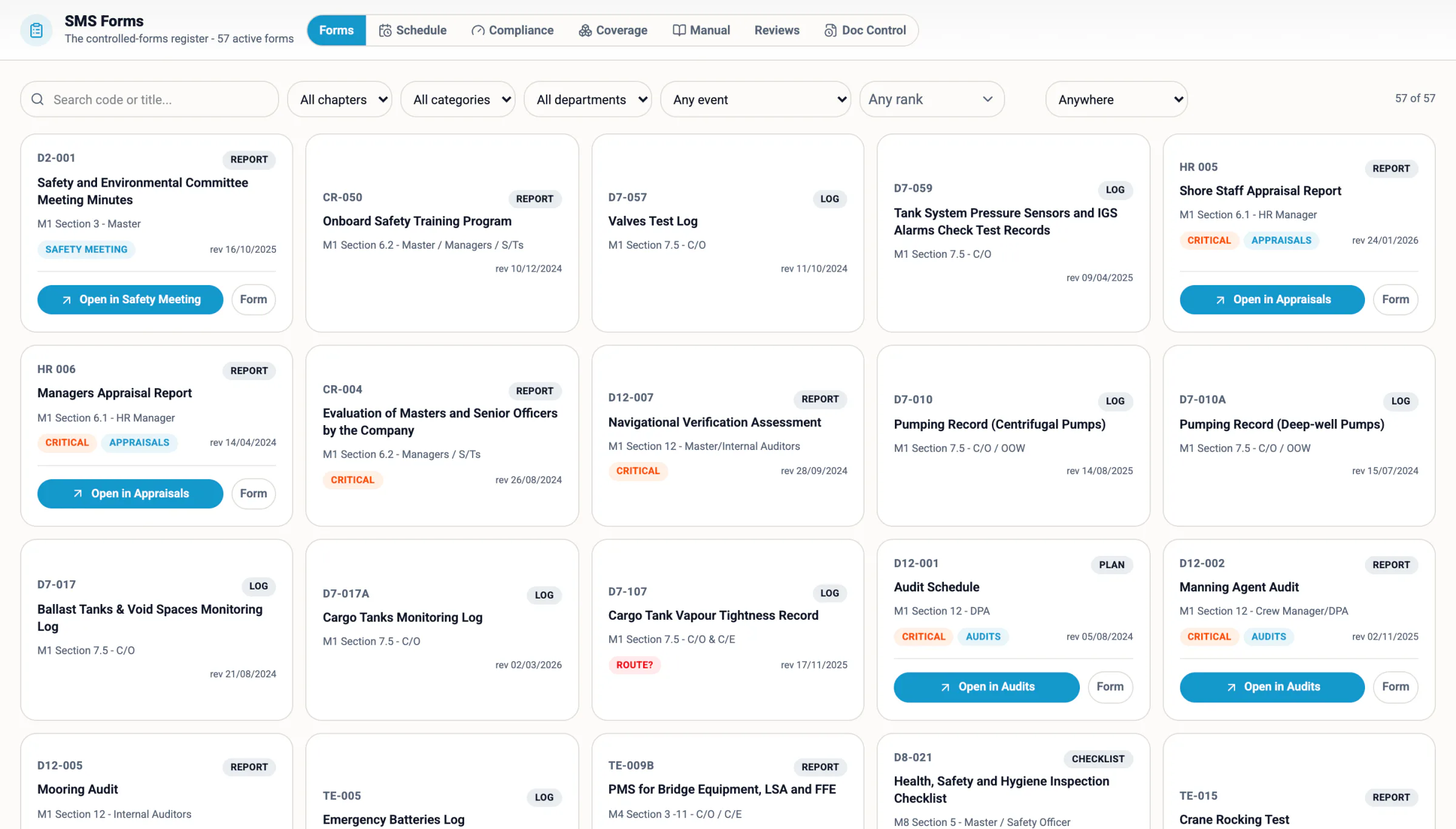
Every form of the manual with its cadence, its responsible role and its state this period — filled, late, or still only paper.
The safety management system, risk assessments, drills, audits, inspections and Port State Control — filled on board, signed by PIN, filed by themselves into the ledger the auditor opens.
Part of SlashPrime — company operations & ship management, by SlashBackYour own forms, with your codes and revision dates, become interactive. Cadence and role make the schedule fill itself; what was done, on time, completely, and whether the office looked, is a fact per form, per ship, per period.
Your Word and Excel forms become interactive forms — your codes, your wording, your revision dates — filed into one ledger keyed to the ship and the period.
The library by department, the assessment attached to the permit before it is issued, and the gaps listed worst first.
Every seafarer against every drill subject, coloured by interval, so the overdue drill is visible before the inspector asks; the monthly safety committee with its minutes.
Internal audits question by question: a failed answer opens a finding, the finding gets a corrective action with an owner and a deadline, and the queue shows who owes what.
Deficiencies per inspection, repeat findings, detentions and PSC risk, benchmarked year on year on Paris and Tokyo MoU principles.
Hours of work and rest checked against MLC 2006 and STCW as they are entered, non-conformities named per person per day — the record PSC opens first.
Every form of the manual with its cadence, its responsible role and its state this period — filled, late, or still only paper.
The point is not that the module exists — every vendor has one. It is that it reads and writes the records the rest of the company uses, so nothing is exported, imported or reconciled between them.
The vessel, the seafarer, the supplier and the job are one record each, wherever they appear. No middleware between modules.
The ship carries her own copy, works without a link and syncs by herself. Every form is signed by a named crew member with a PIN.
Apple's Claris FileMaker platform: TLS in transit, AES-256 at rest, a named account for everyone, off-site backups that cannot be altered.
A website can show you screens. It cannot show you your ships on them. The demo can — with your vessels' names, your ranks and your SMS forms index loaded, in front of the people who will use it. Forty-five minutes, online or at your office.
One email with your fleet size and the department that hurts most. We reply the same working day with two slots for a call.
We load your vessel list beforehand, so the fleet board, the obligations register and the ship's screen show your ships, not ours.
Crewing, procurement or compliance. A fixed-scope onboarding, your users, two training days, and a decision after thirty days of real use.
 Claris Partner — certified on the FileMaker platform, Pro and Server. Runs on Mac, Windows, iPhone, iPad and the web. Request an offer.